
People rarely come to a leadership course hoping to become better at saying, “Let’s circle back.” They usually have something more pressing in mind. A team needs direction. A promising employee needs development. Someone in upper management needs convincing. A manager has left, and nobody is entirely sure which decisions they were making or why the budget spreadsheet contains fourteen hidden tabs.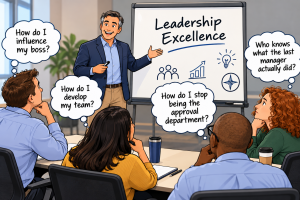
During my recent facilitation of the Leadership Excellence course for UNH Professional Development & Training, participants shared the knowledge and skills they hoped to gain. Their interests ranged from becoming more influential to building high-performing teams. They wanted to develop younger colleagues, give managers greater ownership, and create positive organizational cultures. Some faced immediate challenges, including launching a newly chartered team or managing the fallout from a manager’s departure.
I heard two connected questions beneath them:
- How do I help people want to contribute?
- How do I organize the work so their contributions actually produce results?
The first points toward motivation theory. The second points toward operational performance. Both deserve attention. An enthusiastic team can still spend its entire Tuesday waiting for approval.
Influence: Getting Beyond “Because I Said So”
Becoming a more influential leader and influencing upper management were both areas of interest. I see these as related challenges. In either direction, a leader is asking how to shape a decision when authority alone will not do the job.
Victor Vroom’s expectancy theory offers one useful lens. It connects motivation with people’s beliefs about whether effort can produce successful performance and whether that performance will lead to an outcome they value. In plain language, someone considering your proposal may be wondering:
“Will this work?”
And, reasonably enough, “Why would I want the result?”
That makes influence more demanding than delivering an enthusiastic presentation. It asks us to understand the other person’s expectations.
For managing up, I would use this lens to examine a proposal before presenting it. Have I explained how the requested resources could produce the intended result? Have I connected that result to something senior management actually values?
“This would make my department happier” may be an honest opening. It may need a little more development before the capital-budget meeting.
The same reflection applies when leading a team. If I ask people to take on a difficult assignment, I should be prepared to explain why success is plausible and what makes the work worthwhile. “Leadership is very excited about this” leaves a remarkable amount unexplained.
Motivation: People Are Not Office Equipment With Feelings
The desire to give managers more ownership connected naturally with participants’ interest in developing people. Self-determination theory provides a useful starting point. It identifies psychological needs involving autonomy and competence, alongside relatedness, the experience of meaningful connection with others. Workplace research connects support for these needs with more autonomous forms of motivation. There are several motivational theories that help explain the challenges here, from Maslow’s Hierarchy to McGregor’s Theory X and Theory Y to Herzberg’s Two-Factor Theory (Motivation-Hygiene Theory). For me, the practical question is whether our management practices support those needs or quietly work against them.
Consider the instruction: “Take ownership of this project. Please obtain my approval before making any decisions.” That is an unusual ownership arrangement. Even rental cars allow you to choose the radio station.
Autonomy does not mean abandoning a manager with a cheerful “You’ve got this!” and disappearing until the quarterly review. I would translate the theory into a more deliberate conversation about decision authority and available support. Which decisions belong to the manager? When should they seek help?
Those questions also make room for competence development. Someone may need practice before taking on a responsibility independently. Someone else may already be capable but trapped in an approval process designed when fax machines were considered disruptive technology. Those are different problems. Sending both people to the same confidence-building workshop would be convenient, if nothing else.
Developing Younger Colleagues Without Consulting Their Birth Certificate
Participants also wanted to develop younger team members. I would begin with the individual rather than a theory about their generation. What can this person already do well? Where do they want to grow?
Self-determination theory offers questions that do not require a generational stereotype: Does the person have meaningful ownership? Are there opportunities to develop mastery and experience connection at work? A conversation built around those questions seems more useful to me than announcing, “Young people today want everything immediately.” Every generation eventually discovers that sentence. Apparently, it arrives with the first unexplained backache.
I would also distinguish age from experience. A younger colleague may need guidance in one area while knowing considerably more than their supervisor in another. The Hersey & Blanchard Situational Leadership Model, the Skill-Will Matrix, and the Five Levels of Delegation can be useful here.
The development conversation should leave room for that possibility. Otherwise, mentoring risks becoming a lengthy explanation of how things worked before the person asking the question was born.
High Performance: Busy Is Not a Result
Participants’ interest in high-performing teams raised an operational question: How would we know the team was performing well? “Everyone is extremely busy” is an observation. It is not yet a performance standard. There are 2 ways to look at this: qualitative and quantitative.
Qualitatively, Patrick Lencioni identified the 5 dysfunctions of a team shown in the figure.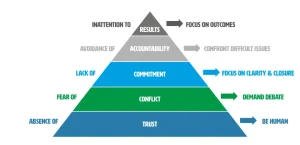
Quantitatively, Locke and Latham’s goal-setting theory helps explain why specific, challenging goals can support performance better than vague instructions to do one’s best. Feedback helps people judge progress and adjust their approach. Goal commitment and the demands of the task also matter.
That gives me a useful contrast: “Improve responsiveness” sounds agreeable. “Reduce the time customers wait for an initial response, while monitoring whether their issues are actually resolved” gives a team something more concrete to examine.
The second statement still needs a baseline and a realistic target. At least it allows a conversation about results beyond whether everyone appears sufficiently exhausted.
For a newly chartered team, I would begin by asking what outcome the team owns. Then I would clarify its decision authority. A charter can document those answers. An acronym cannot substitute for them, although it may fit better on a coffee mug.
Operational Performance: Find the Bottleneck Before Scheduling the Pep Talk
Motivation theories help us examine willingness to contribute. The theory of constraints directs attention toward what limits the system’s performance. Its central approach is to identify the constraint preventing a process from achieving its goal and focus improvement efforts there. Lean methodologies can also help identify waste. This differs from trying to make every part of the operation busier or more efficient in isolation.
Imagine a team that prepares proposals quickly but waits two weeks for one person’s approval. Asking everyone to prepare proposals faster may simply produce a larger queue outside that person’s inbox. The queue is now more impressive. The result is not.
For the leaders interested in high performance, I would bring the discussion back to where work waits. Is there a decision bottleneck? Does the team repeatedly redo work because requirements become clear only after submission? This is where motivation and operations meet. Before asking why people lack urgency, I would want to know whether urgency has anywhere useful to go.
And before commissioning a workshop on accountability, I would check whether the person authorizing every minor decision is me. A deeply inconvenient diagnostic possibility.
When a Manager Leaves, the Process Map May Leave Too
“Managing fallout from a manager leaving” stood out because it suggested an immediate concern rather than a general development aspiration. Without knowing the circumstances, I would not assume what the team was experiencing. I would ask what had become unclear. Which decisions no longer have an owner? What work is waiting? A Swimlane Process Map, as shown in the figure, can be usefule here. The constraint lens is helpful here because it encourages us to look for what now limits the flow of work, rather than assuming that everyone simply needs to try harder.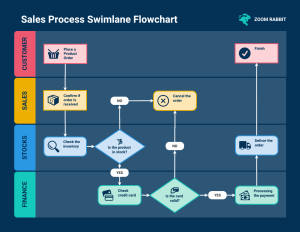
A departure might reveal that one person held essential knowledge. It might also expose an approval arrangement nobody had questioned because the previous manager somehow kept it moving. “Somehow” is doing considerable work in that sentence. My interest would be in restoring workable decision paths while identifying what needs to be documented or shared. Recreating the departed manager’s heroic workload would not be my first choice of succession strategy.
Culture and Transformation: What Would People Notice?
Participants also wanted to develop a positive organizational culture and strengthen their transformational leadership skills. I would make both ambitions concrete. What would people experience differently when they raised a concern? What would a manager be permitted to decide that currently requires approval? This ties in with the previous question about process.
Several motivational theories offer questions about the conditions surrounding people’s work. Operational theories offer questions about how that work reaches a useful outcome. Neither perspective, by itself, answers every leadership problem. For me, the connection is credibility.
If I say I want initiative, I should examine what happens when someone takes it. If I announce a commitment to better performance, I should be willing to investigate a process that I created. That is the version of transformation I would want to explore in class: a change people can experience in the work itself. The new logo can wait.
And now, an FAQ for the Aspiring Leadership Enthusiast
Can I motivate people with a pizza party?
You can certainly invite them to lunch. Whether that answers their concerns about decision authority is a separate agenda item.
How do I give managers ownership while approving everything they do?
You could call it “closely supervised independence.” I would still suggest clarifying which decisions are actually theirs.
My team is constantly busy. Doesn’t that prove we are high-performing?
It proves you will have trouble finding a meeting time. I would want to see what the activity produces before ordering the commemorative jackets.
What if I am the bottleneck?
That would be awkward. It would also give you unusually direct access to the person who can change the approval process.
How do I develop younger employees?
I would start by asking what they want to learn. You can save the presentation about how difficult your first job was for a longer power outage.
Our manager left. Should we immediately reorganize?
I would first find out which responsibilities need an owner. Moving the boxes on the organizational chart may be satisfying, but the unanswered customer request remains surprisingly uninterested in the new reporting structure.
Can I create a positive culture by announcing an open-door policy?
Certainly. Then comes the interesting part: what happens when someone walks through it with information you do not enjoy.
How do I influence upper management?
I would explain the problem and connect the proposed action to an outcome they care about. The seventeen-slide account of how nobody appreciates your department may need to remain a private creative project.
How quickly can I become a transformational leader?
For a modest start, choose one decision your team can genuinely own. Then let them make it without receiving a surprise director’s cut.
If you want more insights like this, be sure to subscribe to this blog!