

IDEA Blog #10: Supervisor Bootcamp: Answers From the Management Wilderness
At a recent UNH Supervisor Bootcamp, I facilitated a panel discussion with David Le e and Brooke Moran, brave souls gathered to confront the ancient mysteries of leadership: How do I inspire people? How do I give feedback without triggering a three-act tragedy? Why does my peer supervisor guard the copier like it contains state secrets? Here are a few field-tested, mildly humorous answers from the Seven Creatures of the Supervisor Bootcamp.
Inspiring Others: How to get employees to buy in/excited to come to work everyday?
You cannot make employees leap out of bed every morning shouting, “Yes! Another Tuesday!” unless you operate a bakery, an animal shelter, or perhaps distribute lottery tickets. But you can  make work feel worthwhile. People buy in when they understand the purpose of the work, have some real say in how they do it, receive recognition for effort and results, and believe their supervisor notices that they are human beings rather than interchangeable keyboard attachments.
Try connecting everyday tasks to a visible outcome: “This report is not just a spreadsheet; it helps students get answers faster,” or “Your careful scheduling prevented three people from arriving at the same meeting room with the same projector and increasingly hostile expressions.” Celebrate progress, remove obstacles, and ask people what would make their work easier or more meaningful. Inspiration is less about delivering a rousing speech from a conference-room table and more about making it possible for people to succeed without needing a rescue helicopter.
Gentle Feedback: How do you provide feedback to someone who takes it personally (very personally)?
When someone takes feedback very personally, remember that their internal translator may turn, “Could you add the attachment next time?” into, “You are a catastrophic disappointment to your ancestors.” Your job is to make the message clear, specific, and as low-drama as possible. Focus on observable behavior, its impact, and the needed change: “In yesterday’s email, the attachment was missing. The team could not review the document before the meeting. Please use the attachment checklist before sending future updates.”
Do not cushion the message so thoroughly that it becomes a marshmallow and nobody can find the actual feedback inside. Be calm, private, respectful, and direct. If emotions arise, acknowledge them without retreating from the point: “I can see this is frustrating. I’m raising it because I want you to be successful, and we need to correct it going forward.” Feedback is not a character review, a personality diagnosis, or an invitation to debate whether gravity is unfair. It is information about work and what needs to happen next.
Managing Up: How to make higher-ups listen to your demands
Making higher-ups listen to your “demands” may be difficult, largely because executives tend to respond better to “well-supported recommendations” than to a  supervisor entering the room with a clipboard and a megaphone. Managing up means understanding what your leaders care about—risk, budget, service quality, compliance, employee retention, deadlines—and framing your request in those terms.
Instead of saying, “We desperately need another person,” try: “Our current staffing level is creating a two-week response delay, increasing error risk, and pulling experienced staff away from priority work. Adding a 20-hour position would reduce the backlog and protect the service target.” Bring options, evidence, and a clear recommendation. Then make it easy to say yes: specify what you need, why it matters, what it costs, and what happens if nothing changes. This is not manipulation; it is translation—from “my team is drowning” into the dialect of decisions.
Managing Down: How to communicate information from upper management with which you don’t agree
One of the more uncomfortable supervisory moments is delivering a decision from upper management that you did not personally choose, endorse, carve into a stone tablet, or invite to dinner. The temptation is to begin with, “I completely disagree with this, but…” That sentence may win a moment of popularity, but it can also leave your team wondering whether anyone is actually steering the ship.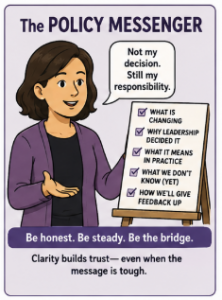
Instead, be honest without becoming the office resistance radio station. Explain what is changing, why leadership says it is changing, what is known and unknown, and what it means in practice. You can say, “This was not my preferred approach, and I understand the concerns. Our responsibility now is to implement it well, identify problems early, and share useful feedback upward.” Your team does not need you to pretend every decision is brilliant. They do need clarity, steadiness, and confidence that you will advocate for them while helping them move forward.
The Unwilling Mentee: How to mentor others for growth who are okay with their current role and capabilities?
Not everyone wants to climb the career ladder. Some people look at the ladder and say, “That seems tall. I am comfortable right here.” That is not necessarily a  lack of ambition; it may be a healthy preference for mastery, stability, work-life balance, or simply not attending more meetings. A good mentor does not treat every competent employee as an unfinished executive.
Start by asking what growth means to them. It might mean becoming more skilled in their current role, taking on a project they enjoy, learning a new tool, mentoring a colleague, or becoming less stressed at 4:45 p.m. Growth does not have to mean promotion. Respect their current aspirations while still setting clear expectations for job performance, adaptability, and required learning. The goal is not to turn everyone into a future vice president. It is to help people remain capable, engaged, and ready for the changes that inevitably arrive wearing the disguise of “a small process update.”
Peer Relationship: How do you establish relations with another supervisor who is has no interest in forming a relationship (territorial)?
Every workplace has at least one territorial supervisor: the person who treats information as a rare forest creature and cross-department collaboration as an unauthorized border crossing. You cannot force a peer relationship, but you can create conditions in which cooperation becomes easier—and isolation becomes less useful.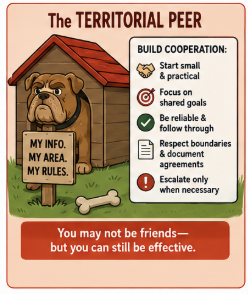
Begin with practical, low-stakes contact. Ask about shared workflows, coordinate around a mutual problem, offer relevant information, and follow through reliably. Avoid trying to win them over with a dramatic “relationship-building meeting” titled *Let Us Become Colleagues and Trust One Another*. Instead, build credibility through repeated, professional behavior. Keep boundaries clear, document agreements when necessary, and escalate only when the territorial behavior harms employees, customers, operations, or institutional goals. You may never become lunch buddies, but you can still establish a working relationship built on clarity, consistency, and the mutual desire not to create more emails.
Friend Vs. Boss: How do you lead/supervise a team you were just promoted from within?
Being promoted to supervise former peers is a little like being cast as the referee in a game you were playing five minutes ago. Your friendships do not have to 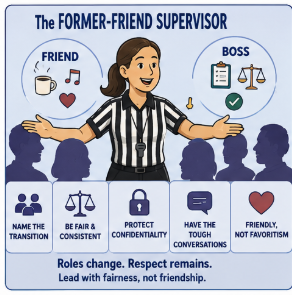 disappear, but the role has changed. You now have access to information you cannot share, decisions you must make, performance issues you must address, and a responsibility to treat everyone fairly—even when one person knows your favorite karaoke song.
Name the transition directly: “Our relationship matters to me, and I also need to be clear that my role now includes making decisions, setting expectations, and addressing concerns consistently.” Then do exactly that. Avoid overcorrecting by becoming colder than an HR compliance video, but also avoid giving friends special access, inside information, or exceptions. Consistency is kindness here. Your former peers will watch whether standards apply equally, whether you can handle difficult conversations, and whether you are still approachable without becoming everyone’s unofficial advocate against management. Be friendly, be fair, and remember: you can still have friends at work; you just cannot manage through friendship alone.
Final Thought
Supervision is not about having every answer, delivering perfect speeches, or somehow making everyone excited about a 7:30 a.m. budget meeting. It is about showing up with clarity, courage, curiosity, and just enough humility to admit when the printer, the policy, or the people situation has defeated you temporarily.
The good news is that great supervisors are not born wearing name badges and carrying color-coded feedback forms. They are built one conversation, one difficult decision, one repaired relationship, and one well-timed cup of coffee at a time. Keep learning, keep listening, and keep leading with both accountability and humanity. Your team may not remember every memo—but they will remember how you made it possible for them to do their best work.